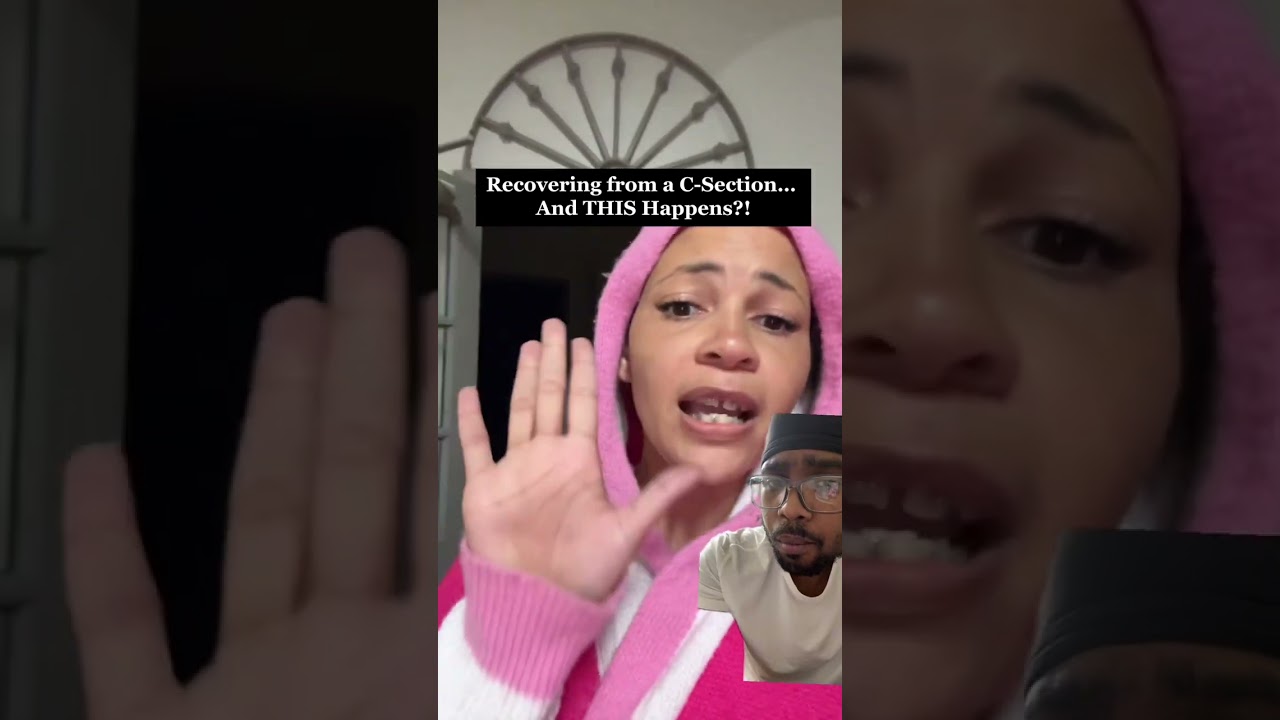
Let's Set the Scene, Because the Details Matter
We need you to really sit with this for a second. A C-section is not a minor procedure. It is major abdominal surgery — layers of muscle and tissue cut through, a recovery that demands rest, limited movement, no heavy lifting, and absolutely no stress if you can help it. Doctors typically say six to eight weeks before you're anywhere close to feeling like yourself again. The first few weeks? You are genuinely fragile in a way that's hard to describe unless you've lived it.
Now picture this: just weeks into that recovery, this mom strapped her newborn up, got herself onto a bus, and traveled to be somewhere for her baby's father. That alone tells you something about where her head was — she was still showing up, still trying, still putting herself through physical discomfort because she believed in this relationship or at least in co-parenting it into something functional.
And what did she get for that effort? She was left waiting outside. For hours. With a newborn. Postpartum. After a C-section. We're going to need a moment.
The Emotional Weight of Being Left — Especially Right Then
Here's what people who haven't experienced postpartum recovery sometimes don't fully grasp: the vulnerability isn't just physical. Your hormones are doing something genuinely wild. Your body is healing while simultaneously trying to sustain another human life. Your emotional bandwidth is basically a phone at four percent battery — everything feels louder, sharper, more devastating than it might at any other point in your life.
To be abandoned in that state — left standing outside, waiting, with a baby in tow — isn't just inconvenient. It's a message. Whether he meant it that way or not, the message received is: you are not a priority. Your healing doesn't matter. Your sacrifice doesn't register.
And the cruelest part? She couldn't even just leave easily. She came by bus. She had a newborn. She had a body that was still knitting itself back together. Every minute of that wait wasn't just frustrating — it was physically taxing in a way that someone without a fresh surgical incision simply cannot understand. The fact that she endured it says everything about how much she was trying to make things work. The fact that he let it happen says everything about where she actually stood.
The Red Flags Hidden in Plain Sight
When we react to stories like this one, we always try to zoom out and ask: were there signs before this moment? Because this kind of behavior — leaving a postpartum woman stranded with a newborn — doesn't usually materialize from nowhere. It's almost always the loudest expression of a pattern that was already there, just easier to explain away before a baby made everything higher stakes.
The red flags in a situation like this tend to look like: a partner who treats his needs as default and yours as a request, someone who accepts your sacrifices without matching them, a person who is present when it's convenient and absent when it costs him something. The bus ride she took is a perfect encapsulation of the imbalance — she moved her healing body across the city with an infant because she thought it was important. He couldn't be bothered to open a door.
We also think about what it takes to even get to the point of making that trip. You don't haul yourself onto public transit weeks after surgery unless you've already been conditioned to believe that your showing up will fix something, smooth something over, keep the peace. That conditioning is its own kind of red flag — not about her character, but about what the relationship had already taught her to do.
What We'd Be Asking Ourselves in Her Shoes
We're not here to tell this mom what she should have done — she was surviving, and survival doesn't always look like the clean decision we'd make from the outside. But if we're being honest with ourselves and with you, here's where our heads go.
The moment you are left waiting outside for hours with a newborn while recovering from surgery, something has to shift internally. Not necessarily dramatically, not necessarily immediately — but something. Because what just happened is data. Real, undeniable data about who this person is when you need him most.
The question this story keeps raising is one we think about a lot on this site: how do you protect yourself and your child when you're still in the thick of loving someone who isn't loving you back properly? There's no easy answer. But the first step is usually the hardest one — letting yourself see it clearly, without the filter of hope or exhaustion or the fear of doing it alone.
She already showed she could do hard things. She got on that bus. She managed that baby. She survived that wait. The question of what comes next for her is still unfolding — and we're rooting for her to choose herself with the same determination she used to show up for him.
Our take
Curtis and I talked about this one for a while after we watched it, because it hits differently when you really think about the physical reality of what she went through. This isn't just a 'he was inconsiderate' story — this is a woman who had her body surgically opened weeks before, got on a bus with a newborn, and was left outside like an afterthought. That's not a bad day. That's a pattern revealing itself at the worst possible moment. What gets us is how much she was still trying. The trip itself is the evidence. You don't do that unless you're still all-in on someone. And the tragedy is that her all-in met his barely-there. We're not here to villainize anyone, but we are here to say: postpartum women deserve softness, not this. Full stop.
A healing body and a newborn deserve better than hours on a curb — and the moment someone shows you they can't meet you there, that's information you have to be brave enough to use.