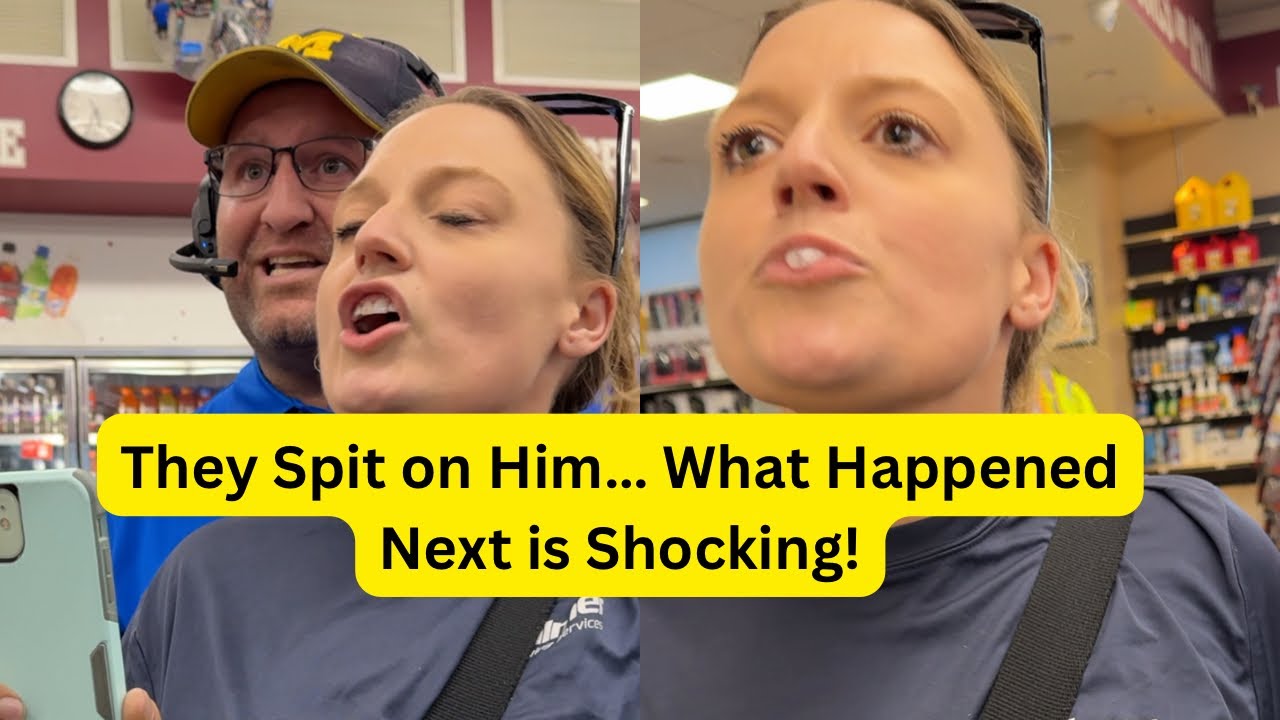
The Honk That Started Everything
Let's set the scene: a truck stop, which — if you've ever been to one — is basically a controlled chaos zone on a good day. Big rigs, tight spaces, people moving in every direction, and about twelve different near-misses happening before you even finish your coffee. In this environment, communication is survival. A quick honk isn't aggression, it's the language of the road. It means 'hey, I'm here, don't back into me, let's all go home safe tonight.' That's it. That's the whole message.
So when this truck driver — in uniform, on the job, doing exactly what experienced drivers are trained to do — gave a courtesy honk to warn a couple whose vehicle was backing toward him, he wasn't starting anything. He was trying to prevent something. Most reasonable people would get that. Most reasonable people would maybe throw up a hand, course-correct, and keep it moving. This couple? They took it as a declaration of war.
Taunts, Insults, and Then — Spitting
Here's where it crosses from 'awkward parking lot moment' into something genuinely disturbing. Rather than accepting the warning for what it was, the couple turned on the driver with hostility that escalated fast. We're talking taunts, we're talking insults, and then — spitting. On a uniformed worker. In public. At a truck stop where, we'd like to point out, there are almost certainly other people watching.
We need to pause on the spitting because that is not a 'heated argument' move. That is a specific, deliberate act of dehumanization. It's the kind of thing that communicates 'I do not see you as someone who deserves basic dignity.' And the fact that this driver was in uniform makes it hit different — this is someone doing a job that keeps shelves stocked and supply chains moving, getting spit on for trying to keep everyone's bumpers intact.
What's wild is how the couple's reaction reveals so much about their internal logic. Somewhere in their heads, a warning honk registered as a threat or a slight — something to be punished rather than appreciated. That kind of hair-trigger hostility toward a stranger doing them a favor? That's not about the honk. That's about something else entirely, and this driver just happened to be standing in the blast radius.
Red Flags, Real Talk, and What This Escalation Actually Looks Like
We talk about conflict escalation a lot in the Messy Stories universe, but usually it's in the context of relationships — the slow burn of a marriage falling apart or a friendship curdling over years. What makes this story so jarring is the speed. This goes from zero to harassment in the time it takes to finish a parking maneuver. That's a red flag pattern worth naming:
First, there's the refusal to accept neutral intent. A honk is a honk. Choosing to interpret it as aggression when there's zero evidence of aggression is a choice — and it's a choice that says more about the person making it than the person honking. Second, there's the public performance of it. Taunting and insulting someone in a public space, in front of witnesses, suggests these two weren't embarrassed by their behavior — they were energized by it. Third, and most critically, the spitting. Once someone crosses into physical contact — even contact as 'small' as spitting — the situation has fundamentally changed. It is no longer just an argument.
For the driver, every instinct in that moment had to be pulling in different directions: the professionalism of being in uniform, the very human desire to defend yourself, the practical reality of being at work in a public space. Navigating all of that while someone is actively disrespecting you is genuinely hard, and we don't think enough people acknowledge that.
When the Driver Decides He's Had Enough
The recap asks the question that's been sitting in the back of your mind this whole time: what happens when the driver decides he's had enough? And honestly, that question is doing a lot of heavy lifting here, because it's the same question we'd all be asking ourselves in that moment.
There's a version of 'enough' that looks like walking away. There's a version that looks like pulling out a phone. There's a version that involves other people at the truck stop getting involved — because trust us, truckers look out for each other, and bystanders at a truck stop are not the same as bystanders at, say, a shopping mall. The community is different. The stakes feel different.
What we know is that this encounter was captured — the detail about it unfolding 'in real time' and the #CaughtOnCamera tag tells us this didn't just disappear into the ether. Someone documented it. And documentation changes everything about how a story like this can end. Whether that's accountability, whether that's just the record existing — it matters. The couple who decided a safety honk warranted spitting on a uniformed worker didn't just have a bad day. They made choices. And choices, especially the ones caught on camera, have a way of following people.
Our take
Curtis and I watched this one back-to-back and we were both just sitting there like — WHO raised these people? Because the entitlement required to spit on someone who was actively trying to help you avoid a fender bender is a level of audacity we genuinely cannot compute. We've both had moments in public where someone did something annoying and we had to talk ourselves down from saying something petty. That's normal. But there is a canyon of difference between 'I'm irritated' and 'I am going to physically spit on a stranger in uniform at a truck stop.' That couple made a choice in every single moment of that escalation and chose wrong every time. The driver, though? Handling that with any amount of composure while in uniform? Respect. Genuine respect. We're rooting for him hard.
A courtesy honk is not a provocation — and how someone responds to unexpected kindness tells you everything you need to know about who they really are. Some people are just looking for a fight, and the best thing you can do is make sure they don't get to drag you down with them.